


- History
- 5 de February de 2026
- No Comment
- 12 minutes read
The Women Rebels of the Tragic Week, 1909

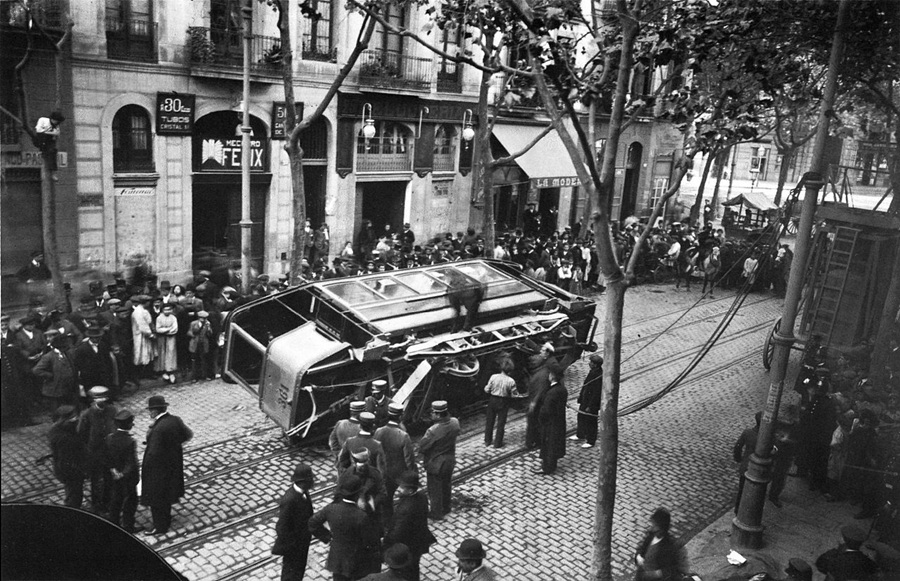
Tram overturned. / Wikipedia – By Charles Chusseau-Flaviens – Museu George Eastman


Soledad Bengoechea
The Tragic Week is the name by which the popular uprising of an anti-militarist and anticlerical character that broke out in Barcelona between 26 and 30 July 1909 is known. Initially directed against the recruitment of young men to be sent to the war in Morocco, the revolt soon turned into an anticlerical rebellion, which turned the city’s churches and convents into prey to the flames.
Its immediate origin lay in opposition to the relaunching of the Moroccan colonial venture, promoted by mining interests in the Rif. The uprising erupted when the Minister of War decided to dispatch to Africa an expeditionary force of more than 40,000 men, most of them reservists who were married and had children. The embarkation of troops in Barcelona began on 11 July, and in the days that followed anti-war demonstrations and incidents took place at the port and in the streets. The atmosphere was one of popular irritation, shared by nationalist republican, radical and socialist parties, against a war that was widely misunderstood. Between 19 and 25 July, disturbances and clashes between local residents—men and women—and the police occurred on a daily basis, while the climate became increasingly radical, fuelled by campaigns in the left-wing press and despite the public-order measures taken by the governor, Ángel Ossorio y Gallardo.
On Monday 26 July, workers’ organisations called a general strike against the war, which was unanimously supported, with the sole resistance coming from tramway workers. That same day, the Captain General, De Santiago, declared a state of war, and the governor, who disagreed with the decision, resigned. Perhaps because people were quite literally roasting in that scorching summer, the fact is that the response of the crowd overflowed the strike committee and took on an unforeseen insurrectionary character, without the republican parties being willing to assume leadership. Barcelona filled with barricades, and the people—workers, artisans, prostitutes, housewives—everyone took possession of the streets. Churches and convents were set on fire by the crowd, in the face of the army’s passivity. And people watched. In total, some 80 religious buildings—half of those existing in the city—were destroyed, and—exceptionally—three priests were killed; the bodies of several cloistered nuns were also exhumed and paraded through the city. The lack of external support for the rebels, the arrival of new military forces and the internal deterioration of the uprising shifted the balance of the struggle on 28 July. By the 30th, troops had taken control of the last rebel strongholds, and by Monday 2 August normality had been fully restored. The toll was 3 dead and 27 wounded among the forces of order (official figures), and between 75 and 100 dead, with hundreds wounded, among the civilian population.
The neighbourhoods that erupted during the Tragic Week were working-class areas. People from different social backgrounds still lived fairly close together. As Dolors Marín explains:
“Women took to the streets, accompanied by young men and children. It was they who disrupted the embarkation of soldiers. They were the ones calling on them to rebel […] weavers, ironers, seamstresses, spinners, cooks, domestic workers, nannies and teachers joined in. […] medals, scapulars and packets of tobacco offered by bourgeois ladies were thrown into the sea…”
Some Women of the Uprising
Let us now take a closer look at some of the women from the neighbourhoods—agitators, rebels—who took to the streets during those July days of 1909. It is necessary to study this issue in depth: the participation of women during the Tragic Week. References to these women have been uncovered through the analysis of documents relating to their arrests. Thanks to this material, we know that the sentences initially imposed on them were severe, but were later reduced to very lenient terms.
ALAUCH JÉRIDA, Carmen was a member of the Damas Rojas1 of El Clot and part of the women’s section of Alejandro Lerroux’s Radical Party. She was married to a fishmonger and was a well-known Lerrouxist agitator. She began her career as a combatant during that week. On the first day of the events, she actively took part in the attack on a police station in the El Clot district. The following day, she recruited adolescent youths to continue the fight. At the end of the conflict, she was accused of having encouraged the disturbances. However, in the published transcript there was no ruling concerning her case. It is likely that her neighbours in El Clot did not testify against her.
PRIETO, Josefa was the owner of a brothel located in the heart of the Paral·lel2. She was well known in the area. She had been imprisoned on several occasions for attacking the police (probably when they attempted to shut down her business during disturbances). In the evenings, at the tavern—before Josefa began “working”—she would gather with men from the neighbourhood. Everyone shouted and cursed, drinking a small glass and wondering how they would make it through to the end of the month. During the events of those days, Josefa mobilised various delinquents and vagrants. Armed with rifles and pikes, they erected barricades. Josefa was the captain of the barricade on Carrer del Migdia. She was brought to trial by a military court and went into exile in Perpignan. In 1910, she was part of a Comitè per a la Defensa dels espanyols Expatriats (Committee for the Defence of Expatriated Spaniards).
AVELLANEDA, Encarnación took part in the barricade fighting on the Paral·lel as assistant to the commander-in-chief, Josefa Prieto. For these actions, Encarnación was brought to trial in October 1909.
CLARAMUNT CERVERA, Emília was a militant member of the CNT (National Confederation of Labour). Born in Alcoi in 1897, she was the daughter of the anarchist leader Josep Claramunt i Creus, younger brother of the renowned anarchist and feminist Teresa Claramunt. She was a prominent activist during those days.
ANGLADA, Adela led, together with Rafael Fernández (known as Noi de la Veu), the burning of the parish church of Sant Pau del Camp—an ancient Benedictine monastery located in the Raval3—and the convent of the Hieronymite nuns, situated in what is now Plaça del Padró, on the site of the present-day Church of El Carme.
ESTELLAR, Rosa, known as la Valenciana, played a prominent role in another district, Poblenou—the neighbourhood of chimneys and factories, a working-class area marked by social injustice. The memory of the reprisals suffered by local workers after the general strike of 1902 was likely still alive. On 27 July, nervous and with her hands bare, Rosa Estellar helped to build barricades. Some neighbours peered through them at the soldiers on the other side. Rosa, fearless, standing upright with a pistol in hand—probably with bullets tucked into the pockets of her apron—forced residents to open the street gates (it was a gated street), so that rebels could fire from the rooftops at the police. She was brought to trial in December 1910.
RUFO, Natividad was an anarchist who worked as an ironer in Barcelona—a hard, poorly paid job. She probably ironed clothes for well-to-do families. Was resentment a factor in her decision to take to the streets? During that week, she was an active militant of the anarcho-syndicalist union Solidaridad Obrera. Two days after the conflict began, on 28 July, she acted together with her lover, José Ginés Perea (an anarcho-syndicalist organiser), at the barricades on Carrer de Sant Pau (a street leading onto La Rambla). A very forceful woman, she was one of those who led the attack on the Veterans de la Llibertat barracks on Carrer Sadurní and who maintained the barricades the following day. For this, she was arrested and sentenced to “permanent exile”. Rufo and her companion were deported to France.
NORAT, Francesca, known as La Gallinaire, led a female band that operated in Sant Gervasi during the night of 27 July. It is unlikely that she lived there; she had probably travelled to the area. Sant Gervasi was not a working-class neighbourhood. She was arrested and brought to trial. Her defence lawyers were members of the Radical Party, including Rafael Guerra del Río, Josep Puig d’Asprer and José Ulled.
LLOPIS BERGÉS, Maria—or Carmen, though on the Paral·lel she was known as Quaranta Cèntims—she was a prostitute. At the time, Barcelona had around 600,000 inhabitants, of whom some 12,000 were engaged in prostitution, a very high number for a port city, then as now; only Marseille and Shanghai surpassed it. We are in the early years of the twentieth century, in the Poble-sec district and, more specifically, on Avinguda del Paral·lel. The neighbourhood was buzzing with artistic activity, in which women played a central role. We know nothing more about Quaranta Cèntims’s life or about the circumstances that led her into this profession. She did not come from a bourgeois background shedding its strict morals, nor was she a music-hall or theatre star seeking fame. She seemed to have too few chances to make history. She was a working-class woman, widely known as a prostitute—a marginalised and stigmatised occupation. Everyone knew her as Quaranta Cèntims. During those days, Maria took an active part in the disturbances. In her surroundings, in Poble-sec, the churches of Santa Madrona la Vella (now Lourdes), the parish centre, the convent of the Sortidor nuns and two small convents—one on Carrer de Grases and another at the top of Carrer de Tapioles—were set on fire. The school of the Hermanos de la Doctrina Cristiana, located where the library now stands, was also burned. On the Paral·lel, Maria Llopis led a band of men and women who smashed furniture and windows in cafés that refused to close, overturned a tram and attacked a Civil Guard patrol. Maria climbed onto rooftops and clambered up lampposts. During the uprising, she was arrested and sentenced to death. Her sentence was eventually commuted to permanent exile.
ARDIACA MAS, Joana was a worker and rebel in Barcelona, affiliated with the Dames Radicals1. Her father was an anarchist who had served a prison sentence in Montjuïc in 1899. During those days, Joana helped to proclaim the mythical (for anarchists) general strike and took part vigorously in the riots. There is evidence that she was involved in attacks on convents and police stations, as well as other street actions. She was arrested and charged as an instigator, organiser and leader of the events. On 10 November 1909 she was released for lack of evidence and was fully exonerated the following year.
MONJE ALCÁZAR, Mercedes, in the early hours of 26 July, left her home determined to harangue a large group of workers gathered in Plaça de Catalunya. The aim was to urge them to prevent the embarkation of troops. Fearlessly, she confronted a lieutenant of the Civil Guard and was arrested, accused of having incited the population to rebellion. Subjected to a court martial, she was acquitted.
1 A women’s activist group linked to Alejandro Lerroux’s Radical Party in early twentieth-century Barcelona.
2 A lively entertainment district in Barcelona in the early 1900s, combining music halls, taverns and theatres with a predominantly working-class environment and intense political street life.
3 A densely populated inner-city district of Barcelona historically associated with working-class housing, poverty and migration, and known in the early twentieth century for its intense social unrest and anticlerical activism.
Source: educational EVIDENCE
Rights: Creative Commons