


- Opinion
- 13 de February de 2026
- No Comment
- 8 minutes read
Educational triage

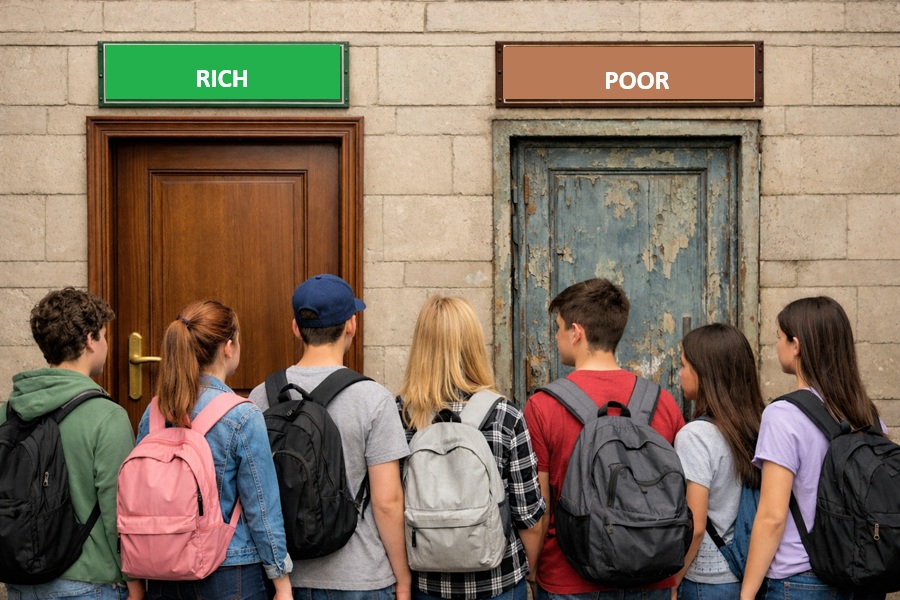
Image created by AI



We have a profoundly distorted—fetishistic and almost superstitious—understanding of the liquid modernity we are living through. We elevate free-market ideologies and their charismatic leaders without a moment’s reflection. Pedagogical gurus are precisely that: salespeople for specific products, solutionist products that feed on social fear. Twenty years ago, Zygmunt Bauman, in Liquid Fear, seemed almost to prophesy our current social condition, particularly in relation to technical innovation: “At the stage we have now reached, a large part of everyday ‘progress’ consists in repairing the direct or ‘collateral’ damage caused by past and present attempts to accelerate it. The tasks that lie ahead of us as a result of such crisis-management exercises tend to be less manageable than previous ones. And there is no way of knowing which of the drops so eagerly poured into it will finally make the vessel overflow—that is, which of the successive interventions will irreversibly turn the next task into an ‘unmanageable’ one”.
My hypothesis is that the LOMLOE, in its grotesque display of absurd pedagogical contortions and genuflections, was precisely that drop which made the glass overflow in Spanish education. Impossible forms of individualised learning; curricula as useless as they are incomprehensible; a technological rupture that has materialised as an unprecedented economic windfall; an official shitstorm of threats and unfulfilled promises (the purges of disobedient civil servants once announced by Celaá; the “Spanishisation” of Catalan children invoked by Wert; the academic support measures supposedly meant to compensate for growing deficiencies, promised both by Alegría and her predecessor; the recently proclaimed two-year master’s degree…). New excesses, new utopias leading straight to dystopia. The damage caused by irrational “progress” can no longer be remedied through managerial homeopathy and ever larger doses of infantilising pedagogism. Nor will injections of neo-feudal retro-technology be of much use. Believing in the Three Wise Men would be a far more mature and adult stance than placing faith in the endlessly celebrated Jacques Delors report.
“Progress” leads us into unforeseen situations, and we then attempt to “progress” once again merely to correct the “deviations” produced by earlier rounds of “progress”. This has been the logic of educational policy for the past thirty years: attempting to control a collapse largely caused by diversionary innovation, until reaching the present point of no return, where the pathological LOGSE-to-LOMLOE cycle has turned a basic social service into little more than reactive chaos.
Bauman reaches the heart of the matter when he explains why the ideals of the Enlightenment have failed—or appear to have foundered—today: “In stark contrast to the strategy implicit in Kant’s categorical imperative, modern rationality progressed towards freedom, security or happiness without asking to what extent (if at all) the forms of freedom, security or happiness it designed were suitable to become universal human properties. So far, modern reason has served privilege rather than universality, and the desire for superiority and for secure foundations for that superiority (rather than the dream of universality) has been its driving force and the source of its most spectacular achievements”.
The problem, then, was not the foundations of liberal modernity or democracy themselves, but the fact that they were used to emancipate only a minority elite. The universality of Enlightenment progress and its emancipatory vocation were abandoned, because it made little sense to improve the lives of only a few: the Kantian proposal had meaning only if applied to the vast majority. Today, the economic elite has used so-called competence-based reforms to further restrict access to neo-Enlightenment gains. The result is tablets and video games for the poor and the battered middle classes, and specialists, textbooks, culture and active access to technology for a tiny minority. This brutal classism is increasingly being labelled the cognitive divide”. For the poor: competence-based fast food. For the rich: philosophy and the capacity to shape algorithmic governance.
Our organic education laws generate a sinister form of educational triage, mirroring what already occurs in healthcare. The project consists in removing the overwhelming majority from any contact with theoretical thought. The economic elite gains access to governance and managerial positions, while for the rest of society full economic citizenship remains an unattainable horizon. The “surprise” comes when (inevitably) mythical neuroses resurface, when conflicts of coexistence fuelled by various forms of polarisation return, along with intolerance and tribal sectarianism—phenomena that predominated before the consolidation of the Enlightenment project. Pedagogical moralism is incapable of containing these anxieties, which lack any meaningful outlet.
What is required, therefore, is planning rather than stumbling blindly forwards. Redistributing knowledge in order to redistribute income. Competence-based reform is the clearest symptom of our transition from formal democracy to market post-democracy—or its slightly more degraded logical outcome: electoral autocracy. We need to stop, reflect, slow down technocratic “innovationitis”, and stop sowing populist despotism where there should be comprehensive education for future adult citizens. Neither purges, nor the cuts and privatisations typical of the right, nor a hollow progressivism detached from reality can provide sufficient excuses for stabilising the situation. A form of disruptive innovation has ended up disabling our primary source of civil rights. What once served to produce an informed and vigilant citizenry now manufactures consumerist terror and neo-medieval illiteracy. The LOMLOE was not an emancipatory initiative—nor even an inclusive one—but pure capitalist accelerationism. Orality is not a purer state of consciousness than Enlightenment responsibility; knowing less is not knowing more; the furious claptrap of pedagogism is little more than fodder for jokes, satire and memes. The success of accelerationism has meant the definitive shipwreck of the modernising aims originally designed to aspire to universality.
The object of future neo-educational management will be to continue extracting rents by cultivating ignorance amid ruins—never to serve educational interests. The struggle is between capital and the school, not between innovators and teachersaurus. The fundamental deception—that someone can learn without someone else teaching—is now a ridiculous relic, an irritating ghost from another age in which candour and cynicism could still walk hand in hand towards a golden future. That future has now been revealed as one enclosed within systems of control and the production of malaise. A public education system cannot forget the egalitarian vector if it still wishes to resemble a democracy.
There is nothing to restore, and nothing to accelerate. What must be done is to redistribute scientific and humanistic knowledge once again—the core battleground of any genuine progressivism—without replacing education with instant simulacra, without renouncing the principle that all Enlightenment legacies must reach absolutely all learners, freely and in an ordered manner, without discounts or ersatz substitutes worthy of a scorched public landscape.
Source: educational EVIDENCE
Rights: Creative Commons