


- Humanities
- 26 de January de 2026
- No Comment
- 20 minutes read
Antonio Baños: “This whole idea of ‘educating for the future’ makes me laugh”

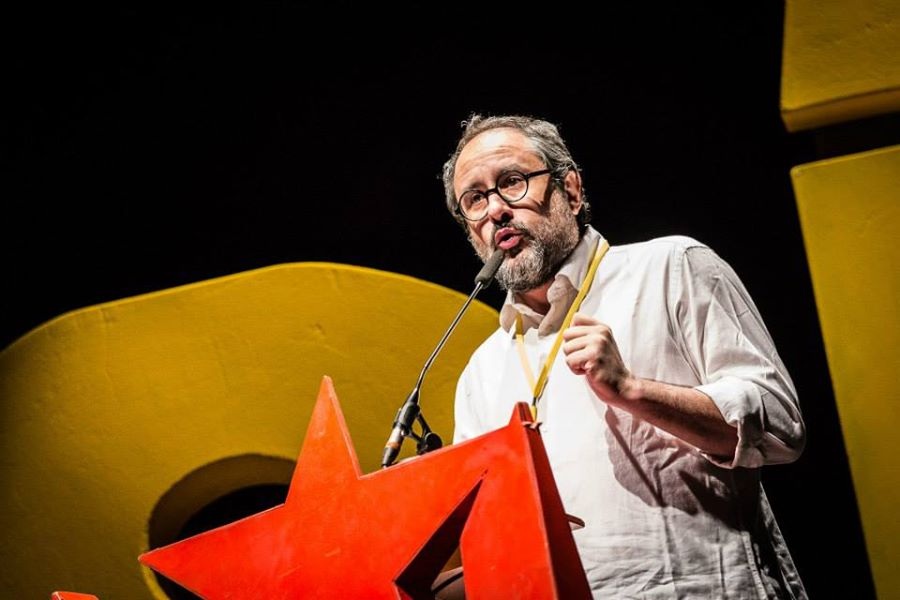



I arrive a little early for our meeting and sit on a bench opposite the Sant Andreu commuter train station, waiting for him. I message him on WhatsApp and he replies: “How poetic! I’m on my way”. What he doesn’t know is that a group of teenagers from the secondary school behind us have just sat down nearby, loudly cursing the exam they’ve just taken—and their teacher. The poetry, as a result, has already turned into something closer to an elegy.
We head to a nearby bar and, over coffee, croissants and a beer, we end up spending no less than four hours talking about education, society, politics and philosophy. At times the conversation becomes hypnotic; at others, comic—but it is always fascinating. It would be impossible to transcribe it all. What follows is a sketch (which, I am sure, means I am ticking at least one box in the curriculum’s competence framework).
Antonio Baños (Barcelona, 1967) is a kind of journalist that scarcely exists anymore—or, as he himself puts it, it’s not that he once worked as a journalist; it’s that he is one, in essence. He has published books on economics, on the political situation in Catalonia in the years leading up to the independence process, and on Barcelona itself. He is well known for having led the CUP’s electoral list as an independent candidate in the 2015 Catalan parliamentary elections, and for his subsequent political trial after 2017. One could define him like this: a journalist, a Catalan, and a born-and-bred Barcelonian (he loves telling stories about his neighbourhood).
He fears for the future of education. He says pedagogism has committed a crime against it: “a movement of hippies who are bad people disguised as good ones, overflowing with supposedly good intentions”, who have dismantled the public aims of schooling. He calls for a politics that truly commits to the public sphere: a long-term view of educational problems deeply connected to our social and political context. And he does so, always, with humour.
How do you see the current state of education in Catalonia?
Bad. Criminal. A crime against humanity. One day we’ll have to hold a Nuremberg Trial for everyone who has destroyed it. I know people who teach at university and tell me they have to spend two hours a week going over spelling and grammar. Students are riddled with anxiety and can’t write. They have enormous cultural deficiencies—cinema, literature, what we used to call general culture. University lecturers have to send books chapter by chapter because students are incapable of reading a book from start to finish.
In many secondary schools, unfortunately, students don’t even have textbooks anymore—they work exclusively on computers.
We are denying them the right to be free and autonomous. It’s a victory for the ruling class. Denying a student Greek and Latin, for example—or any form of learning that improves the individual, not to mention basic literacy—is criminal. A crime against democracy, against social mobility. It’s the most reactionary thing you can do. Hippies base their entire discourse on opposing what education used to be like, and you think: fine—but the problem is that you can’t escape the yoke of ignorance. In life you can rebel against almost anything, except ignorance. There is a clear will to create lumpen individuals: people incapable of making critical judgements because they lack tools, because they lack solid knowledge. The Jesuits taught more—because you can free yourself from the Jesuits’ yoke. It’s better to know the Creed than to know nothing at all.
“A hippie is a bad person disguised as a good one. Hating hippies is a civilisational key”
By “hippies”, do you mean the pedagogists?
Yes. A hippie is a bad person disguised as a good one. Hating hippies is a civilisational key. The posh-hippie-liberal-woke profile. You can tell they’re changing when gastronomy comes into it. The day they stop wearing a Free Palestine T-shirt and start talking about wine pairings, something has gone wrong. They all follow the same narrative arc. They despise shopkeeper values, liberal professions, commitment to one’s word, intellectual curiosity…
Pedagogists try to convince us that education is merely a pedagogical issue. But education cannot be reduced to a matter for experts. Education is not a technical debate between concepts; it is a political debate. In recent years we’ve been trapped in sterile discussions revolving around abstract concepts. The lives of children and future adults are a political matter, because tomorrow they will be citizens and their existence will affect every sphere of life. It’s like water—you can’t say it’s a technical issue that doesn’t interest you; it’s the condition for life. And although techniques may change, there are things that always remain and must always be known.
What do you mean?
This idea of “educating for the future” makes me laugh. You can’t educate for the future, because nobody knows what will happen—that’s impossible. You educate about the past, in the present. All this talk about educating for a changing society… nobody knows how it will change. The world has always been changing. You educate so that children have tools to face a future we don’t know.
The same applies to technology. Saying that putting technology in the classroom is “the future” is a lie. Any technology you introduce into the classroom as a substitute always comes from the past. What education should incorporate is the past and reflection upon it—not listening to these oracles who tell us we must systematically demolish the past because it was wrong. You may escape the yoke of the past, if necessary—but not the yoke of ignorance.
“You can’t educate for the future—that’s impossible. You educate about the past, in the present”
This relationship between past and future seems central. It feels as though it all leads us to a problem in how we relate to history—especially on the part of a certain left that has forgotten that its very purpose is to engage in a deep conversation with history.
Absolutely. There is a clear mistreatment of history in the current system. There’s also a desire to make the child unique, detached from the past—hence the obsession with giving children names no one else has. I’m just one more Antonio in a long lineage of Antonios. Take microchips: a next-generation chip contains all the components of previous chips, literally. Silicon Valley doesn’t reinvent the chip every day. But politicians and pedagogists don’t care about that—they just want the latest chip, without understanding how it’s made. All the problems political parties face stem from their inability to guarantee a promise of the future. The same applies to pedagogists. Does the Bofill Foundation really know what education will look like tomorrow? Jean-Claude Michéa has been very clear in criticising the intrusion of the idea of “the future” into classrooms.
Pedagogists downplay knowledge transmission and discipline. What do you think?
What exactly are we not supposed to transmit? Catalan? Family bonds? What’s wrong with transmitting? You can’t be a teacher and refuse to transmit knowledge. The moment you answer a question, you transmit something. It’s absurd. They just don’t want certain things transmitted—because if you transmit those, you’re a fascist. When Mar Hurtado said on TV3, the Catalan public television, that discipline was military and therefore wrong, she was answering a question. Answering a question is transmission as you are transmitting a message. It’s nonsense. Of course we should reflect—politically, above all—on why we obey certain forms of power. But in the case of teachers, authority is obvious: they are trying to teach you. That alone establishes a relationship of authority. It’s common sense. Respect flows from that. We’re destroying common sense because there are agents interested in dismantling whatever brings order to life. They’re nihilists: they see hidden structural power relations everywhere, which only they can supposedly detect. It’s deeply depressing.
“We are destroying common sense because there are agents interested in dismantling whatever brings order to life”
Those of us who believe in knowledge transmission are labelled teachersauruses and reactionaries.
The world can only be explained from the past, not from the future. We need to return to solid organisations and solid political traditions. We need to recover the ability to explain things in terms of values—somewhere between civility and humanism.
What relationship do you see between pedagogists and politics?
Pedagogists act because they’re allowed to from above. But they deny responsibility by claiming educational problems are “structural”. They say: educational problems are structural; you can’t see them at first glance—only I can. What have you done? You’ve invented a religion. You’re the priest who reveals “structural problems” no one else can see. This discourse—what we’d now call woke—exists because it belongs to a bureaucratic caste. They haven’t realised that they don’t bother power at all by saying these things. Bureaucracy is brilliant at dissolving responsibility—Max Weber already said that. And our education system is bureaucratised. We don’t have professors in gowns strolling along Fabra i Puig talking about arkhḗ; they’ve all passed through bureaucratic filters.
No one takes responsibility for education—Damià Bardera says this too.
Demanding responsibility for something “structural” is now considered fascist. Relax—nothing ever happens, everything is structural, the system is to blame and you’re its victim.
What is woke in education?
Like everything else, it’s a liturgical left that has forgotten how to reach concrete goals because it’s obsessed with performativity, hidden violence and axes of oppression. Which one do you choose? Marx says you’re born under economic oppression. Freud, under trauma. The Church, under sin. We could go on. Your entire life becomes a negative struggle. No—you’re born full of potential, as someone in a world of possibilities.
They’re statist like authoritarians and incoherent like aristocrats—they combine the worst of all political traditions. The people at Bofill could just as well be in a Buddhist monastery in the Garraf hills, but because they’re backed by the government, they’re now “experts”. They’re as deluded as ever—only now someone is listening. Mind you, I think they’ve lost.
Why do you think they’ve lost?
In the 1990s, American films became popular about schools in deprived neighbourhoods where a military man arrives to impose order and discipline—The Substitute, for example. Progressive buddy-style education fails, and a Vietnam veteran comes in to restore military obedience. But what was needed at the outset was money! The same people who refused to invest then are the ones who’ll now demand order.
We blame the actors, not the director. Neoliberals and wokes can’t see this because they don’t think in terms of property and obedience—the core concepts of the left. I’m an anarchist; I believe in order without authority. But hippies are chaos—they don’t believe in limits. Discipline frightens them because they associate it with the Vietnam veteran.
“Power knows how to give voice and resources to those aligned with its objectives. That’s what’s being exposed now”
Adam Curtis explains how computing and the internet emerged from ideas because events are always preceeded by an ideological climate. On one side you have the original Stanford hippies, dreaming of a horizontal world where everyone is empowered by their computer against the state, something that looks benevolent, progressive and hippie-like. And on the other hand, there’s Reagan—then governor of California—who spots this and begins funding them, since they share a common enemy: the state. Hippies who want to tear down structures and neoliberals who want to get rich (like the Bofill Foundation), despite starting from different ideological positions, they end up converging. Power knows how to give voice and resources to those aligned with its objectives. That’s what’s being exposed now.
You’re outlining a problem that links education and politics. Do educational problems need to be understood within a broader context—transport, healthcare, public broadcasting?
They’re directly linked to our economic model. Look at what Trump did with real estate. Wealthy people move to the suburbs, the city’s tax revenue falls, the council has less money, drug addicts arrive, gangs and prostitution appear, the middle class decides to leave, civil servants leave—everyone leaves. Until Trump puts up a skyscraper, Rudy Giuliani comes in, money is injected into public services, and suddenly everything works again. Is that a Machiavellian plan, or is it just business?
—Or both at the same time.
This may sound like a conspiracy, but it isn’t one. I’m not saying there are secret dinners at Via Veneto or satanic rituals going on. What happens is that interests simply align. The real question should have been asked much earlier: what needed to be done to avoid reaching this situation in the first place? Instead of sending in a military figure, like in the films, you should start by asking what kind of economic model you have, why you have such deprived schools, with high migrant populations and so few resources. Don’t just say everything is “structural” and leave it at that—apply a few sticking plasters and blame “the structure”.
The same thing happened with television: funding is cut, audiences fall, executives sell it to a private company, which turns it into a slick, market-driven channel—and ratings go back up. The same with private health insurance. And immigration is also a consequence of this economic model. If immigrants are paid so little because they’re kept on the lowest—or zero—contribution levels, the state becomes unviable. Immigrants don’t collapse the system; what happens is that their contributions are extremely low because the economic system pushes them into precarious jobs. Why are state schools full of immigrant students? Because their parents have no alternative.
What can we do to integrate immigrant students in contexts like mine, where they make up almost 100% of the classroom and where cultural bridges are hard to build?
There are always bridges—you just have to look for them. Take you, from the Horta of Valencia: you share 5,000 years of hydraulic history with a Pakistani student. There are always common grounds. But if you start with melatonin or religion… one is irrelevant and the other non-existent. That said, I imagine it must be extremely difficult, and I’m not going to tell you how to do your job. Neoliberal and woke doctrines assume that people can’t understand each other because they have different individual origins. But it’s precisely in that abyss that the possibility of politics and knowledge emerges—something both neoliberals and wokes deny. You may not understand each other on the basis of the Qur’an, but you can understand each other on the basis that door-to-door rubbish collection is a disaster, for example.
“We need one outlook focused on coexistence, and another on authority. We also have the right to say where the limit lies—and that’s something a certain left struggles with”
We need one outlook focused on coexistence, and another on authority. We also have the right to say where the limit lies—and that’s something a certain left struggles with. Why is same-sex marriage persecuted in some contexts, but not the fact that a Muslim girl doesn’t attend gymnastics because she would have to change clothes, or the use of the veil? Why is one seen as horrific, while the other is framed as something that must be respected as “culture”? Where is the limit? Both are based on the idea that women must obey men. We need to focus on shared ground. Do you want your child to receive an education and respect older people? Then tell them to listen to me as an educational institution. Either you accept the cultural abyss and widen it, or you try to build bridges. The key is consensus and the civil code.
And what about Catalan? What do you think of the recent survey on social language use?
What matters here is the law. Someone who comes from abroad will usually do what the law requires. If the law says you need Catalan to work, for example, they’ll learn it. In the smallest canton in Switzerland, if German is mandatory, immigrants speak German. Laws are always cheaper than other civic actions—and more effective.
It’s like the housing crisis: it doesn’t really exist. What exists is a completely deregulated market, which would change if it were regulated. Making something compulsory is cheaper than constantly trying to “sell” Catalan or make it seem friendly. Nobody talks about the unfriendliness of Dutch. I’ve never seen anyone promoting the “likeability” of Catalan in Ljubljana. There, Slovene is mandatory and no one questions it.
The problem in Catalonia is that we have a very floating population—people constantly coming and going, who don’t put down roots. That makes everything much harder. We don’t create conditions for rootedness, but the political and economic system does create conditions for the ethnic and linguistic minoritisation of Catalans. A lot of work could be done through extracurricular activities, community centres, and adult self-education through reading. Political power could intervene much more in this.
What do you think about the idea of a dual school network, with some schools offering genuine Catalan-language immersion?
It makes me uneasy, because it confuses cause and effect. We need to start by deciding what kind of economic model we want, because the current one is based on importing cheap labour and on low-productivity sectors. In that context, education is also devalued, because there’s no economic promise or prospect of prosperity linked to educational attainment.
It’s absurd to look for solutions to problems that could be solved at the root. The Basque Country has less immigration and a GDP ten points higher. Learning Basque pays off—you can stay and earn money. If you’re Argentine and come to Barcelona for a season, as they say, and then move on to London, nobody puts down roots. We can’t change the education system just to adapt ourselves to contingency.
“I’d like pedagogists to be afraid—afraid of the consequences of their actions”
It’s like the issue with doctors. Entry grades are extremely high, and we have the problem of a single district system. We need to disobey that law. We can’t put ourselves at the service of an abnormal reality. The real problem is that we don’t have a genuine bourgeoisie, a national bourgeoisie. What we have are people living off a plantation-style economy and property rents—that’s who generates this system.
The people at Foment del Treball should leave Catalonia. We should surround their building. We can’t be ten million—there’s no money. Either we’re ten without fiscal extraction, or seven with it. That’s straightforward social democracy. If you want to be Spanish, we can’t.
What can be done to fix the educational disaster?
I want pedagogists to be afraid—afraid of the consequences of what they’ve done. I’m in favour of using threat. I don’t understand why we should be kind to people with such a clearly destructive agenda. We cannot allow impunity. We need to realise that education is the most important thing we do in life. And that’s what they want to take away from us? No. Organisation—and standing our ground.
Source: educational EVIDENCE
Rights: Creative Commons