


- Opinion
- 20 de March de 2026
- No Comment
- 6 minutes read
Resisting

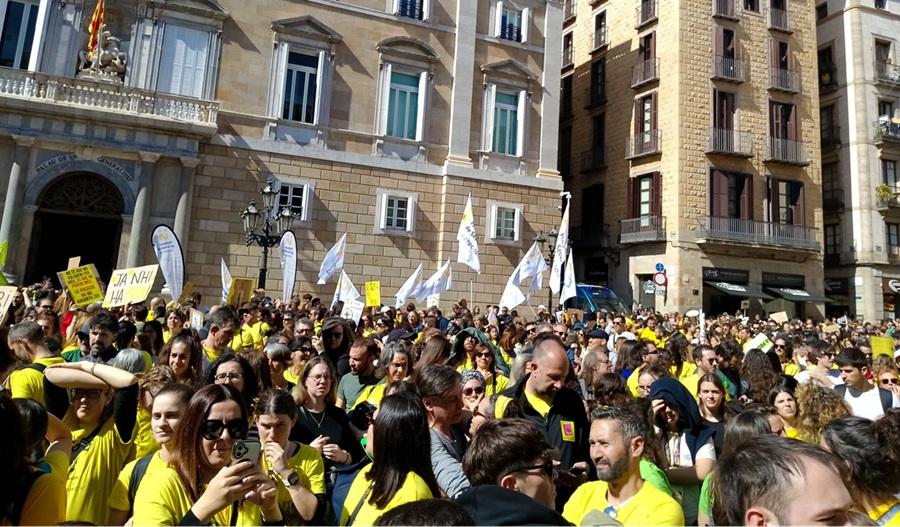
Catalan teachers in front of the Palau de la Generalitat (seat of the Catalan government) during this week’s demonstration. / Photo: Sindicat Professors de Secundària



José Luis Villacañas, Professor of the History of Philosophy at the Complutense University of Madrid and one of our most complete and influential thinkers, who seems incapable of stopping writing books, has just released Senderos que se bifurcan (Arpa). In this work he sketches the basic coordinates of where our society and our education system currently stand. His essay rests on a fundamental idea: throughout the history of humanity, imperial projects have been opposed to governmental ones, so that our political crossroads can be explained from the arrival of Homo sapiens and the age of the pharaohs all the way to the streets of Minnesota.
In his conclusions he explains that “each and every one of these imperial powers has always needed one thing: to produce a form of mental homogeneity capable of guaranteeing the obedience of the subjected. From the first to the last, from the pharaohs to Trump, they have attempted to create a political theology — a firm union of religion and politics capable of governing both bodies and souls. Political theology is the aspiration to achieve the government of the soul in order to domesticate human freedom as far as possible”.
And, pay close attention to this key paragraph, he adds immediately afterwards: “Every attempt to domesticate freedom will always tend to limit the autonomous psychic work of the individual. The most effective means of dominating the soul is the generation of disorientation. When confusion reigns within the psyche, the unrestricted authority of someone will always be promoted”. This is the true meaning of competence-based educational reforms, including in our own country: to curtail “psychic work”, to suppress any inclination towards personal autonomy, to impose mental standardisation, and to establish a permanent state of confusion both in students and in teachers.
The emotivism that presides over our pedagogical policies is thus laid bare: “Moreover, in the midst of confusion, impulsive expression becomes far more likely, which has the advantage of providing the subject with a certain sensation of freedom. Yet, as we know, impulsive expression is the furthest thing from any mature understanding of freedom. For the drive always acts against the subject itself: it is a far more effective way of dominating it than terror”. In the old disciplinary society, the police and sadistic teachers were enough. Today, individual annihilation is produced through libidinal saturation and anarcho-capitalist propaganda.
What role do new technologies play in all this? Villacañas has an answer for that as well: “The programme for the domestication of freedom today, as yesterday, makes use of technical innovations. In antiquity it was iron, the wheel and the stirrup that imposed obedience through the terror of war. Later, technical innovation became associated with the art of curing souls — the capacity to remove anxieties and fears, to offer authorities in the face of disorder and mental chaos, organising collective neuroses and psychoses through absolute forms of faith. The aim was always the same: that the secret interior of souls might be known, controlled and revealed to power, in order to anticipate their actions and guarantee obedience”. His proposal is unequivocal: artificial intelligence and social networks swollen with toxicity now constitute the political theology most suited to the “domestication of freedom” — this bankruptcy of the human spirit and of its capacity to define itself, generate mutual trust and live together.
Pedagogism arrived in order to subdue us and turn us into docile beings. Let us insist on what seems essential: pedagogism and its competence-based variant, oriented towards what is now called “employability”, constitute the concrete device of today’s imperial and global political theology. Our empires (the United States, China, Russia) are no longer so interested in conquering our territories as in subduing our minds, and this is the real function of the new technologies and the pedagogical bureaucracies associated with them. The fact that they present themselves as tools of progress and emancipation should by now provoke both laughter and suspicion. The strength and originality of Villacañas’s reflections lie in issuing this warning: a technology that replaces our consciousness and freedom of thought with automatised fashions and systematically mutilated and biased information, aimed at generating extremist fanaticism, is not innocent in the slightest. Today’s authoritarian vector promotes precisely this substitution of culture by an imposed digital standard.
Many of our politicians, commentators and mid-level officials should begin to understand what they are really doing when they collaborate uncritically with these new powers — entirely vertical and authoritarian. The obvious response to this threat lies in restoring everything imperialism detests: literature, philosophy, basic science, dialogue, reasoned history, anti-individualism, collective awareness, mathematical abstraction, sociological and anthropological reflection, human companionship, debate, dialogue, diversity, critical writing — everything that once constituted the proper life of educational institutions and which has been interrupted by the absolutist utopia of techno-power.
Source: educational EVIDENCE
Rights: Creative Commons