


- History
- 4 de March de 2026
- No Comment
- 6 minutes read
Remembering some women esperantists

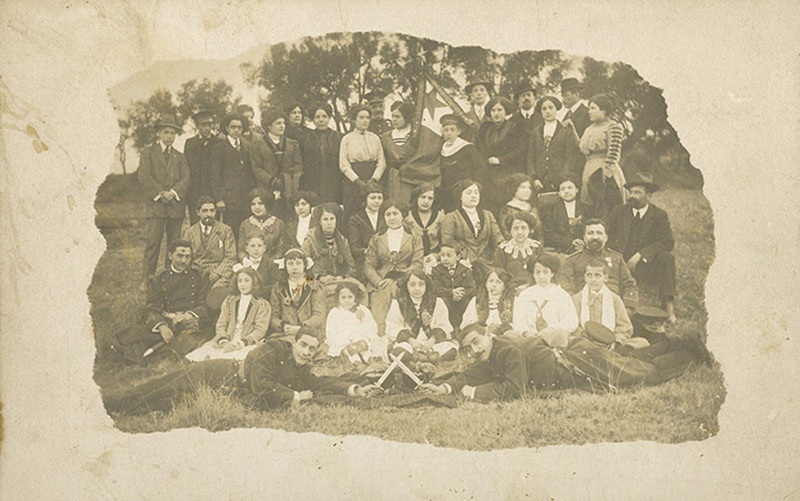
The Esperanto group Amo Kaj Espero from Girona (“Love and Hope”), 15 March 1921. Collection of the Girona City Council (author unknown).


Soledad Bengoechea
The roots of Esperanto are largely based on Latin, with notable influences from Russian, Polish, English, and German. It is the most widely known constructed language, and its popularity appears to be growing. Although it is not the official language of any country, the Esperanto movement remains active, with a particularly strong presence in Europe and East Asia.
Origins
On a warm 26 July 1887, the first booklet, An International Language: Preface and Complete Grammar—*a grammar of the so-called International Language—was published in Warsaw. This artificially created language was conceived as a neutral vehicle for communication between peoples. The work took the form of a forty-page booklet written in Russian. Its author, the young Polish Jewish ophthalmologist Lejzer Zamenhof (1859–1917), signed it under the pseudonym Dr Esperanto (meaning “one who hopes” in Esperanto). That same year, the booklet was published in German, English, and French.
Esperanto offered ease of communication and linguistic equality, and it quickly resonated worldwide with pacifists and intellectuals. The group of individuals committed to peace, freedom, and equality—and now also to Esperanto—was broad, as were the associations that were founded and the conventions that were held.
Esperanto took deeper root in socially transformative ideologies—such as anarchism, naturism, feminism, and pacifism—than in conservative ones. Many working-class groups found in Esperanto an effective means of communicating with people from other parts of the world, particularly individuals from similar social backgrounds, thus putting into practice a tangible form of internationalism. The number of speakers grew gradually over time, although it never received significant support from governments or international organisations. At certain moments, it was even declared illegal, and its speakers were persecuted.
In Catalonia, Esperanto arrived later than in other parts of the Iberian Peninsula and Europe. The first Esperanto association was the Aplec Esperantista de Catalunya, which published the bulletin Espero Katalunjo in 1905—an important step in the dissemination of Esperanto. The language gained notable traction among anarchists and anarcho-syndicalists affiliated with the Confederación Nacional del Trabajo, a trade union founded in Barcelona in 1910.
A small number of women joined the movement. Much of the Esperanto community was composed of members of the clergy, military personnel, teachers, and liberal professionals (lawyers, solicitors, and merchants). Most of them embraced not only the language but also Zamenhof’s philosophy, which extended beyond the linguistic sphere. It constituted the core of a pacifist spirituality that, at its heart, regarded all human beings as members of a single human family.
An Esperanto teacher as an example
Teresa Rosell i Capdevila was born in Vilanova i la Geltrú, in the Garraf region, on an unusually cold winter’s day: 6 February 1872, one year before the proclamation of the First Spanish Republic. She was a determined woman and very much a product of her time. She taught both Catalan and Esperanto.
Rosell worked as a primary school teacher, had studied Philosophy and Letters, and established an unregulated educational centre for girls in her home at 44 Carrer Major, with the help of her sister Eulàlia, who was also dedicated to teaching Esperanto. Working together, the two sisters carried out numerous educational, cultural, and social activities in Vilanova i la Geltrú. By 1909, Teresa was already a member of the governing board of the first association Laboro Esperanta, founded in the town.
She taught for more than thirty years, until the victory of General Franco in the Spanish Civil War (1936–1939), which deprived her of her profession. In addition to their dedication to teaching, both sisters are regarded as important figures in the recovery of local traditions and folklore in Vilanova i la Geltrú, including popular songs and traditional dances.
After the war, in 1939, Teresa and her sister were plunged into poverty, as the new regime forced them to close their academy. They spent the final years of their lives in the Casa d’Empara in Vilanova i la Geltrú, where they eventually died, having been compelled to sell their home in order to gain admission.
How Many People Speak Esperanto Today?
It is estimated that between 100,000 and 2 million people currently speak Esperanto, either fluently or actively, according to various sources. This planned language has an international community and around 1,000 native speakers (denaskuloj), and is experiencing a revival thanks to the internet and social media.
_______
Caption for the Image. Portrait of the members of the Girona Esperanto group Amo Kaj Espero, with the Esperanto flag. To the left of the flag stands Carme Maymí. Carme Maymí and her sister Dolors were members of the association Amo Kaj Espero. On 15 March 1921, the Diario de Gerona de Avisos y Noticias announced the forthcoming celebration in Girona of the 9th Esperanto Congress of the Kataluna Esperantista Federació, to be held from 15 to 17 October. Carme was a member of the organising committee.
Source: educational EVIDENCE
Rights: Creative Commons