


- Cover
- 9 de April de 2026
- No Comment
- 6 minutes read
Gabriel Bertotti: “Borges is God”

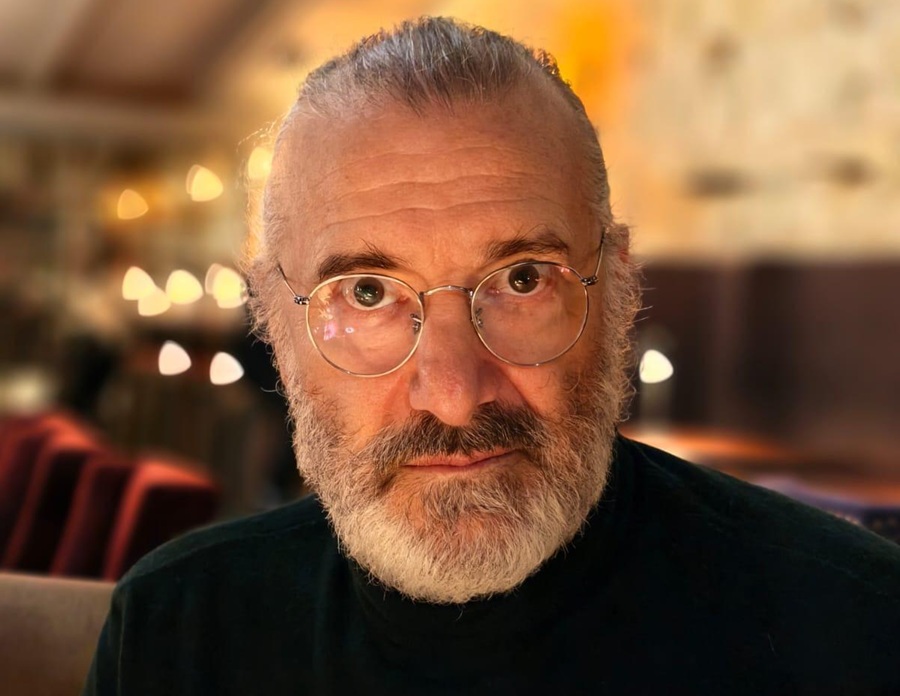
The writer Gabriel Bertotti. / Photo: Courtesy of the author



Gabriel Bertotti (Bahía Blanca, Argentina, 1963) lives in Mallorca. The author of several unclassifiable books, he has recently republished his novel Luna negra (Sloper).
Let us begin with the story of Luna negra itself. How did the text come into being, and how was it first published?
It emerged during my years of wandering across the Iberian Peninsula, selling toy frogs at local festivals—from La Magdalena to El Pilar—during winter stays in Cadaqués and Tenerife, in the watertight den of a Chinese shopkeeper in Barcelona, back when no one yet imagined it would one day be called El Raval, and later in my existential restart in Porreres, in Mallorca.
It was written on scraps of paper, napkins and loose sheets, retyped on an electronic typewriter, and revised to exhaustion on the monochrome computer of a friend’s young son—its keyboard sticky with jam—in Bahía Blanca. It fulfilled an obligatory, initiatory journey that I am glad to have left behind.
It was a finalist for the Tusquets Primer Premio Jóvenes Narradores and passed through Antonia Kerrigan’s literary agency until, twelve years after its completion, it fell into the generous hands of Toni Xumet, who published it with a press that flew too high—Editorial El Sol de Ícaro—only to be brought down, after the 2012 edition of Luna negra, by the hurricane of successive economic crises.
How would you define Eva Mariscal, your protagonist?
As a fusion of Eve newly expelled from Paradise and Lilith—still moist, yet unhumiliated for having dared to mount a God.
What is the Buenos Aires through which your characters drift? What happens to them there?
It is the only real Buenos Aires: the fictional one, the remembered one, and therefore the one reinvented out of experiences so close to dreams, lived during the early years following the return to democracy (1983–1990), and during the disastrous years of Menem, when everyone was hypnotised by a false prosperity concealing a zombie apocalypse—one that would later culminate in the triumph of the undead, embodied by Milei.
The equation is ignominious: the disappeared versus the zombies.
What do you make of Borges and Aira?
Borges is God; Aira, the jester from Dylan’s songs.
“To return, yes—but a different kind of return. Nothing to do with Volver or with Gardel. No journey into the past to recover lost time. In Narigón, there was a process of displacement, of understanding” (p. 97). Could you elaborate?
The childhood home was, in truth, a small house. Parents were not so kind. Many gazes were oblique rather than straightforward. It is a mythological place to which one returns convinced there will be no shadows, that doors will open the other way round.
To reconstruct the past—whether through literature or by taking a flight—grants one the privilege of a time traveller, but also imposes a strict obligation: not to act or interact, not to touch or alter anything. For the return serves only to understand, and is, in essence, an act of existential selfishness that leaves an open wound in those who stayed behind and never made it out.
One must accept that one is a ghost, briefly granted a degree of material presence that expires with a plane ticket—or with the first light of dawn.
What is the temporal structure of your novel?
It is an organised chaos: the interplay between simultaneity—the coexistence of events—and the mind’s need to arrange them sequentially. The narrative thread runs from June 1993 to the events recounted in the third part, one year later. Yet in that mythical Buenos Aires, all times coexist, and by turning down a street you should never have taken, you may suddenly come face to face with the regime’s enforcers, the characters of an immeasurable novel by Bioy Casares, or nameless ghosts.
How do you interpret the ending of Luna negra?
I do not interpret it.
Let us turn to Pasar el rato, which you published two years ago. Is it philosophy, poetry, narrative—or none of the above?
The perfect answer is already contained in the question.
What do you make of Nietzsche?
A prophet, a poet and a musician who followed the reverse path of the Bacchae, sacrificing his human self in order to consecrate himself as the god of excess and cannibalism—remaining for ten years in a vacant gaze worthy of Dionysus, into whom he had been transformed by the syphilitic worms that burrowed into his brain.
“There is no narrative without curiosity or knowledge” (p. 45).
I refer you to the Greeks: Plato in his entirety, and Aristotle.
“The work of art as the resolution of a mystery” (p. 297). Is that so?
Since Oedipus Rex, it may well be.
A question of current relevance: “England has Falstaff; Spain has Torrente. It is no joke, but a vindication and a tribute” (p. 230). Do you truly believe that?
No.
Are writers swindlers?
Yes—but the answer is equivalent to the Liar Paradox.
And I’m afraid to say that, while you were reading my answers, I stole your wallet—in which, curiously enough, I found a snail.
Source: educational EVIDENCE
Rights: Creative Commons