


- Cover
- 7 de April de 2026
- No Comment
- 6 minutes read
Causes of human intelligence

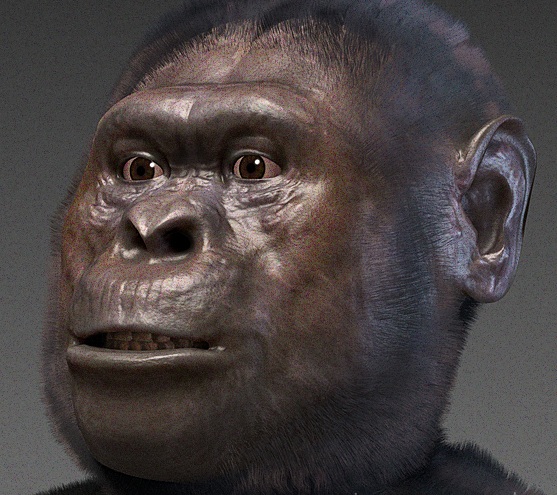
Australopithecus afarensis – forensic facial reconstruction. / Wikimedia. Author: Cicero Moraes


More than two million years ago, shifting ecosystems favoured the emergence of increasingly carnivorous diets among our ancestors. These hominins had already spent over a million years producing lithic flakes and adapting to a more protein-rich nutritional regime. By consuming meat processed with stone tools, as well as bone marrow, they gained access to a concentrated source of calories. Protein offers a higher energetic return than plant-based foods, reducing the frequency of feeding and, potentially, enhancing reproductive rates. Whereas large herbivores must feed daily, large carnivores may do so only every two days or even less often. If tool-making hominins increased their protein intake, it is reasonable to infer a reduction in both feeding frequency and chewing time. Over evolutionary timescales, such changes may have affected the morphology of the face and jaw, the length of the digestive tract, and ultimately brain development. We are thus dealing with a multi-causal system operating through interacting feedback loops.
Mechanically, facial and mandibular growth are developmentally correlated from embryo to adulthood: a larger jaw entails a more projecting face and snout, a condition known as prognathism. Yet hominin evolution appears to have reversed this relationship. A diet richer in animal protein reduced the need for a powerful mandibular apparatus and its associated prognathism. A reduction in facial projection may in turn have facilitated expansion elsewhere in the cranium, particularly in the cranial vault. This should not be understood as a simple causal chain, but rather as the opening of an evolutionary possibility: increased brain volume in conjunction with a reconfigured cranial architecture. As J. B. S. Haldane aptly noted, “comparative anatomy is largely the story of the struggle to increase surface relative to volume”.
If we add to the previous considerations the improvement in caloric intake, we realise that a long intestine was no longer necessary. Under a plant-based and frugivorous diet, the digestive tract had to be much longer in order to ferment and absorb fibrous nutrients. However, after more than a million years of evolution with lithic tools and a higher proportion of protein, this situation must have changed more than two million years ago. With shorter intestines came a greater likelihood of expansion in other organs, such as the brain, all of this favoured by a diet better suited to an organ—the brain—that consumes large amounts of energy. The basal metabolic consumption of the brain in australopithecines is estimated at around 9% of their daily intake. Today, our species has doubled this energetic expenditure, reaching approximately 22%. In caloric terms, therefore, the brain is a very costly organ to maintain. A more energy-dense diet, such as a protein-rich one, may have favoured encephalisation.
If we add to all of the above an environment characterised by numerous social interactions, the need to improve tools, and a form of bipedalism capable of supporting a larger head, the slope becomes downhill. An expanding brain would have been advantageous for social protocols, the recognition of group members, greater efficiency in tool use, and ultimately the improvement of strategies for feeding and reproduction, where higher birth rates increase the likelihood of long-term survival.
In a sense, our brain expanded through a process of co-evolution among different inherited factors; that is, evolution works with what it inherits from the past. These antecedent conditions included, among others, social life among those primates, an encephalisation quotient above average, a more vertical posture with reduced cranial shear stress, and the need to improve their tools. Taken together, and through multiple feedback processes, these factors fostered further encephalisation. There was no single cause or specific effect; rather, everything emerged from a network of relationships that intersected through different positive feedback loops—snowball processes that gained volume as they progressed. With the expansion of clearings and savannahs, at least three major feedback loops associated with encephalisation may have accelerated.
The first feedback loop resulted from the reduction in available plant foods following forest regression. This may have encouraged a greater intake of animal protein such as marrow and meat. As already noted, this could have reduced the number of meals, the time spent chewing, and the length of the intestine—consequences that, in turn, may have allowed the brain, with more calories available, to develop further and to devise more efficient strategies for obtaining protein, thus returning to the starting point of the loop.
The second loop began with the reduction of woodland areas and, consequently, the pressure to move across open terrain. With fewer branches to cling to and in the presence of larger predators, it became advantageous to evolve from smaller apes into larger early humans by seeking more calories from animal protein. In this context, the freeing of the hands made it possible to improve tool production, thereby reinforcing the loop through greater efficiency in feeding.
A third loop may have developed as food resources became more dispersed between forests and clearings. This created the need to travel longer distances, with the associated risks at ground level. In response, greater social complexity continued to evolve in order to minimise predation, which in turn may have further promoted encephalisation over the long term.
Be that as it may, and among many other evolutionary loops, shortly before two million years ago evolution produced a fully encephalised ape that would go on to spread across much of the world. Australopithecus habilis was not among the candidates.
Source: educational EVIDENCE
Rights: Creative Commons